



How to Learn Vocal Singing the Right Way

A lot of students think singing starts with a “good voice.” It doesn’t. When people ask how to learn vocal singing, the real starting point is training your ear, your breath, and your body so your voice can work consistently - not just on your best day.
That matters even more for children, teens, and young adults who want more than casual karaoke. If the goal is stronger pitch, healthier technique, better stage presence, or progress toward performances and exams, singing needs structure. Natural talent helps, but steady development comes from learning the right habits early.
What learning to sing actually involves
Singing looks simple from the audience, but it is a coordinated skill. You are managing breathing, posture, resonance, diction, rhythm, musical memory, and emotion at the same time. That is why beginners often feel frustrated. They may know the song, yet still sound breathy, flat, strained, or unsure.
Learning to sing well means building technique layer by layer. First, the voice has to be free enough to produce sound without tension. Then pitch accuracy has to improve. After that, students start shaping tone, phrasing, dynamics, and style. Performance adds another layer, because singing in a practice room is different from singing in front of a class, an audience, or an audition panel.
This is also why progress is rarely perfectly linear. A student may improve quickly in confidence but need more time with breath control. Another may have excellent musicality but struggle to project clearly. Good training recognizes those differences and gives each singer a pathway that fits their age, level, and goals.
How to learn vocal singing with strong foundations
If you want lasting progress, fundamentals come first. Many students rush to difficult songs too early, especially songs made famous by powerhouse singers. That can lead to throat tension, shouting, and habits that are hard to fix later.
The first foundation is posture. A singer does not need to stand stiffly, but the body does need to be aligned. When the neck, shoulders, and rib cage are tense or collapsed, breathing becomes shallow and the sound loses stability. Young singers especially benefit from learning how to stand and move in a way that supports the voice.
The second foundation is breath management. This is not about taking the biggest possible breath. It is about learning how to inhale without lifting into tension, then release air steadily while singing. Students who run out of breath quickly or push too hard on high notes often need better coordination here, not more effort.
The third foundation is pitch. Pitch accuracy improves when singers learn to hear notes clearly before they sing them. Ear training, call-and-response work, scales, and guided repetition all help. For some students, this develops fast. For others, it takes patient work. That does not mean they cannot sing well. It means they need consistent musical training, not guesswork.
Then comes tone. A healthy tone is usually clear, balanced, and age-appropriate. It should not sound forced. Many beginners copy a dramatic, breathy, or overly heavy style because they want to sound older or more “professional.” In reality, the best training helps each singer develop a natural tone first, then expand stylistically from there.
Practice matters, but smart practice matters more
One of the biggest misconceptions about singing is that more is always better. It isn’t. Thirty focused minutes can do more than an hour of distracted repetition.
A productive practice session usually has a clear purpose. One day that may be breath control. Another day it may be clean diction, rhythm, or memorization. Singing the same full song from start to finish five times often feels productive, but it can hide the actual problem. If a student keeps missing the same phrase, that phrase needs to be isolated and trained.
For younger students, short and regular practice tends to work best. Consistency builds muscle memory without creating vocal fatigue. Teens and young adults can usually handle more detail, but even then, quality matters more than volume.
It also helps to keep expectations realistic. If a student practices twice a week and attends class consistently, progress will come. If they only sing right before a performance, growth will feel slow and unpredictable. Singing is physical training. The voice responds to repetition, recovery, and routine.
The role of vocal coaching and structured classes
This is where many students improve much faster. A trained vocal coach can hear issues that singers often miss on their own, such as jaw tension, breath leakage, unclear vowels, or pushing at the top of the range. Small corrections made early can prevent bigger limitations later.
Structured classes add another advantage: progression. Instead of learning random songs, students move through skills in an intentional order. That may include warm-ups, technique drills, repertoire, musicianship, performance skills, and in some settings, preparation aligned with recognized syllabi.
For parents, that structure matters. It means a child is not just being kept busy for an hour. They are developing skills in a disciplined, encouraging environment with measurable growth over time.
Group classes and private lessons each have value. Group settings can build confidence, listening skills, and ensemble awareness. They are especially effective for younger performers who thrive on energy and shared learning. Private coaching offers more individualized attention and is useful when a student has specific goals such as auditions, exams, solo performance, or focused technical work.
In many cases, it is not about choosing one forever. It depends on the student’s age, confidence level, and ambitions.
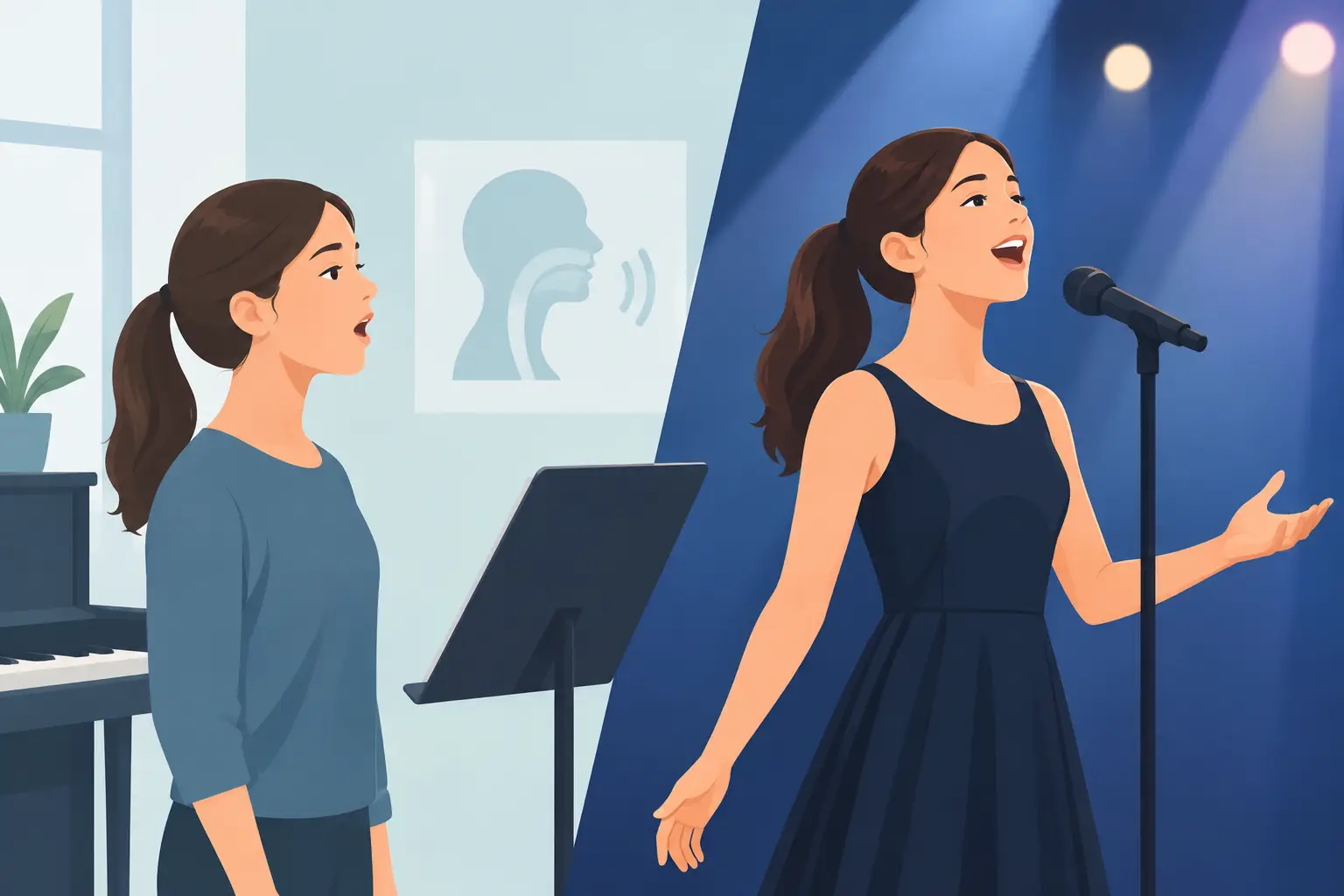
How to learn vocal singing for performance, not just practice
A strong singer is not automatically a strong performer. That difference becomes obvious the moment students step onto a stage.
Performance singing involves communication. The audience needs to understand the words, connect with the emotion, and believe the performer. That takes more than hitting the right notes. It takes expression, facial engagement, physical awareness, and confidence under pressure.
This is why performance-centered training is so valuable. Students who learn in an environment that includes movement, acting, or ensemble performance often become more complete performers. They are not only learning how to sing, but how to deliver a song.
For musical theater, pop performance, and show choir especially, that combination matters. A student may need to sing while moving, harmonize with others, stay in rhythm, and keep their energy up throughout the piece. Training across related disciplines can strengthen stage presence in ways that vocal work alone sometimes cannot.
At MADDspace, that performance mindset is part of what makes training more purposeful for students who want to grow beyond the basics. Technique matters, but so does learning how to use that technique confidently in front of others.
Common mistakes that slow progress
The most common mistake is trying to sound impressive too soon. Students often push for louder volume, higher notes, or a more mature tone before their technique is ready. That usually creates tension rather than improvement.
Another mistake is copying recordings too closely. Learning from favorite artists is natural, but imitation can cover up a student’s real voice. Good training helps singers understand style without losing healthy vocal habits.
Skipping warm-ups is another issue, especially for busy students. Warm-ups do not need to be long, but they prepare the voice to work efficiently. Starting cold and going straight into demanding songs is like sprinting without preparing your body first.
Finally, some students avoid feedback because they want singing to feel easy and expressive all the time. Expression is essential, but correction is how skills improve. The best learning environment balances encouragement with clear technical guidance.
What parents and students should look for
If the goal is real progress, look for training that is age-appropriate, technically sound, and clearly structured. Younger children need classes that build musical confidence without forcing the voice. Older students need coaching that addresses both technique and artistry. Serious learners should also have room to progress into more advanced work when they are ready.
It is also worth paying attention to whether the program develops performers, not just singers. Confidence, discipline, teamwork, and stage readiness are part of strong arts education. Those skills carry into school presentations, auditions, showcases, and everyday self-expression.
A good program should feel encouraging, but it should also have standards. Students grow best when they are supported and challenged in equal measure.
Learning to sing is not about waiting to feel naturally gifted enough to begin. It is about starting with the right guidance, building skill step by step, and giving your voice time to develop into something strong, healthy, and expressive.


Comments