


Do Vocal Lessons Prevent Strain for Young Singers?

A child who loves to sing may want to rehearse the same chorus again and again, sing over loud music, or push for a big belt they heard from a favorite performer. That enthusiasm is worth nurturing. But parents are right to ask: do vocal lessons prevent strain? The honest answer is that quality lessons can greatly reduce the risk of strain by teaching healthier habits, although no class can make a voice invincible.
Young voices are still developing. They need training that builds coordination, confidence, and performance skills without asking them to imitate adult sounds or sing beyond their current range. The goal is not simply to sing louder or higher. It is to help each student use their voice with more freedom, control, and awareness.
What Vocal Strain Actually Means
Vocal strain happens when the voice is working harder than it needs to. A singer may squeeze the throat, force high notes, sing too loudly, or continue singing when tired. The result can be hoarseness, vocal fatigue, a scratchy feeling, a loss of easy high notes, or a voice that feels weak after rehearsal.
One tired voice after an exciting school event does not automatically signal a serious problem. Children can become hoarse after cheering, talking loudly at a party, or recovering from a cold. The concern is a repeated pattern: discomfort while singing, persistent hoarseness, frequent throat clearing, or a voice that does not recover with rest.
Strain is not always caused by poor singing ability. Often, it comes from a mismatch between what a student is trying to do and the technique, stamina, or vocal development they currently have. This is where structured training makes a meaningful difference.
Do Vocal Lessons Prevent Strain Completely?
Vocal lessons cannot guarantee that a singer will never experience strain. A student can still overuse their voice at a concert, shout at a sports game, sing while sick, or practice without enough rest. Individual factors such as allergies, illness, hydration, sleep, and growth can also affect the voice.
What lessons can do is give singers the tools to recognize and avoid unnecessary effort. With a knowledgeable instructor, students learn that a powerful sound should not feel painful or tight. They begin to notice when they are pushing, when a song sits too high or too low, and when it is smarter to pause rather than power through.
For parents, that distinction matters. Good vocal training is not a promise of perfect vocal health. It is a foundation for safer, more sustainable singing habits as a child grows in confidence and ambition.
How Good Training Supports a Healthier Voice
Healthy singing is a coordinated skill. It involves posture, breathing, resonance, pitch, diction, listening, and physical release. When one area is neglected, the throat often tries to compensate.
Breath Support Reduces Throat Pressure
Beginning singers often think that taking a huge breath is the same as supporting the voice. In practice, support is about managing airflow steadily. If too much air rushes out, the singer may press or squeeze to control the sound. If there is too little energy behind the phrase, they may force the throat to carry the work.
In lessons, students can learn how to stand with balance, inhale without lifting the shoulders excessively, and release sound on a steady stream of air. These skills are especially useful in songs with long phrases, energetic choreography, or expressive high notes.
Range Is Built Gradually, Not Forced
Children and teens often want to sing songs by artists whose voices have matured over many years. That is understandable, but copying an adult belt or breathy style too early can create tension. A skilled teacher selects exercises and repertoire that suit the student’s current voice while developing flexibility over time.
This does not mean young singers must stay with simple songs forever. It means progression should be intentional. A student may first strengthen pitch accuracy and an easy middle range, then explore more dynamic control, stylistic choices, and higher or lower notes as coordination improves.
A warm-up is not filler before the “real” singing begins. Gentle exercises prepare the voice for changes in pitch, volume, and articulation. They can also reveal how the voice is feeling that day.
If a student finds an exercise unusually difficult, scratchy, or uncomfortable, that is useful information. Rather than ignoring it, they can adjust, take a break, or tell their instructor. This habit of checking in with the voice is one of the most practical benefits of regular training.
Technique Must Work on Stage
Singing in a practice room and singing during a performance are different challenges. Nerves can make a student tighten the jaw, raise the shoulders, or push for volume. Singing while moving adds another layer of coordination.
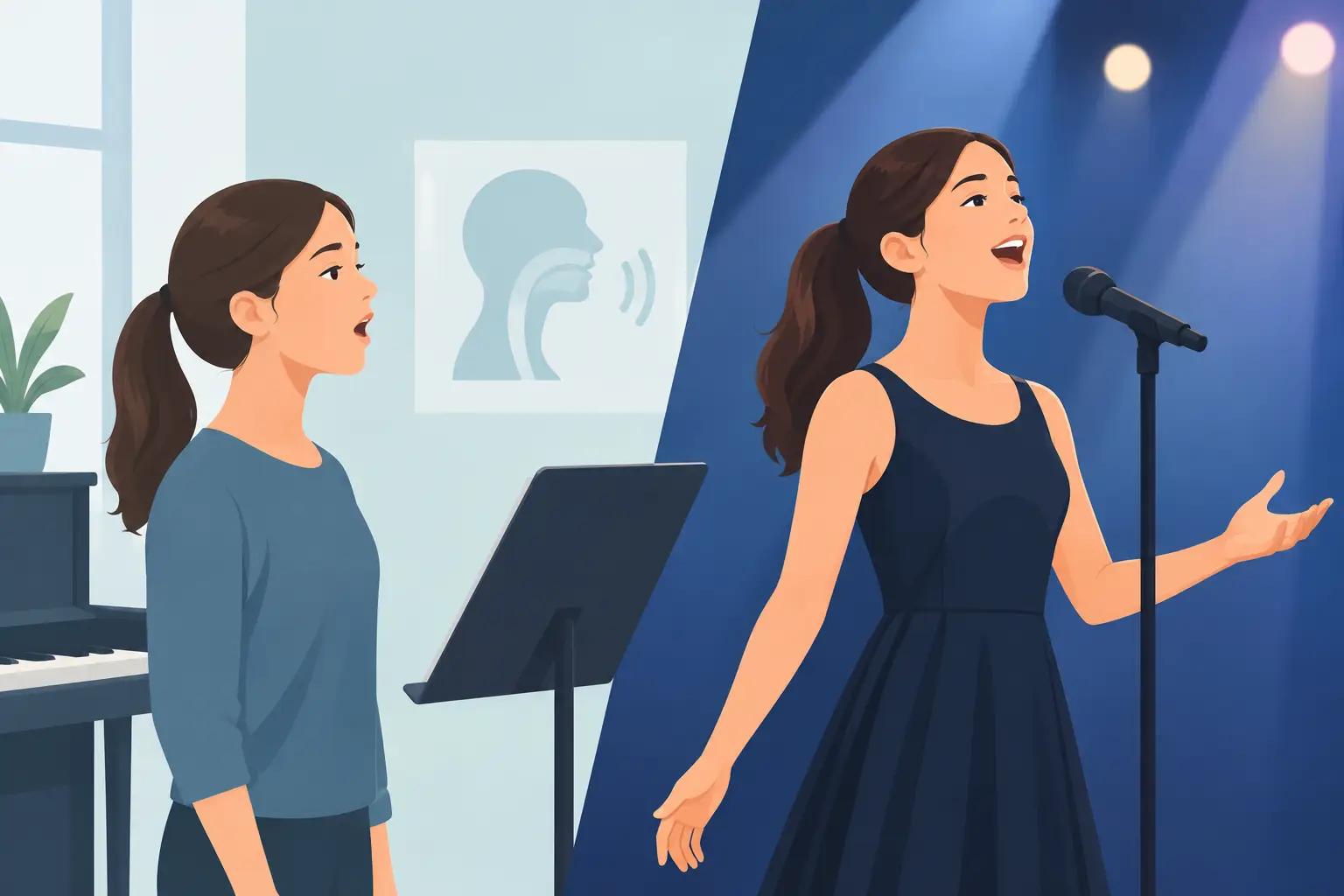
Performance-centered vocal training helps students practice technique under realistic conditions. They learn to keep breath and posture available while communicating lyrics, using expression, and moving with confidence. This is valuable for musical theater, show choir, school performances, and any setting where singing is only one part of the moment.
Why Age-Appropriate Instruction Matters
A preschooler, a preteen, and a young adult do not need identical vocal goals. The voice changes with physical growth, particularly during adolescence, and instruction should respect those changes rather than rush through them.
For younger children, singing classes should develop musical listening, rhythm, clear speech, imagination, and confidence. The emphasis is on joyful participation and healthy coordination, not on demanding vocal effects. As students grow, they can take on more structured work in repertoire, interpretation, range, and performance technique.
During voice changes, some temporary unpredictability is normal. Notes may crack, range may shift, and control can feel inconsistent. This is not a reason to stop singing altogether. It is a reason to work with an instructor who understands how to adapt exercises and expectations. Patience during this period protects both vocal comfort and a student’s confidence.
The Habits Between Lessons Matter Too
Even excellent instruction has limited impact if a singer spends the rest of the week shouting over noise or rehearsing at full volume for long stretches. Healthy vocal use is built through everyday choices.
Encourage young singers to drink water regularly, get enough sleep, and avoid yelling when possible. They should not practice intensely when they are sick, especially if the voice is hoarse or painful. A short, focused practice session with clear goals is generally more productive than repeatedly singing a difficult song at maximum volume.
Parents can also help by changing the language around effort. Praise commitment, preparation, and expressive storytelling rather than only loudness or extreme high notes. The best performances are not always the biggest. They are the ones that sound free, connected, and controlled.
Signs a Young Singer May Need a Break
A singer should stop and reassess if singing hurts. Pain is not a normal training milestone, and it should never be framed as proof that a student is working hard.
Pay attention if hoarseness lasts longer than two weeks, if the voice frequently disappears after singing, or if a student struggles to speak comfortably after rehearsals. Persistent symptoms deserve advice from a qualified healthcare professional, such as an ear, nose, and throat specialist. A vocal teacher can support technique, but medical concerns need medical evaluation.
It is also wise to look at the full schedule. A teen balancing school, dance rehearsals, rehearsals for a production, and private practice may need help planning recovery time. Ambition is valuable, but sustainable development depends on pacing.
Choosing Lessons That Put Vocal Health First
When considering vocal lessons, look beyond whether an instructor can help a student perform a favorite song. Ask how they approach warm-ups, repertoire selection, breath coordination, vocal changes during adolescence, and performance preparation. A strong program should have structure while still responding to the individual singer in the room.
At MADDspace, vocal development is approached as part of the complete performer. Students benefit from disciplined, age-appropriate guidance that supports musical skills, stage presence, and the confidence to grow at their own pace. Whether a child is taking their first steps into singing or preparing for bigger performance opportunities, the right environment makes technique feel purposeful rather than intimidating.
A healthy voice is not built by pushing through every difficult note. It grows when young singers learn to listen to their bodies, trust the process, and enjoy making music for the long run.


Comments