


Top Benefits of Show Choir for Young Performers

A child steps into rehearsal expecting to sing a favorite song. A few weeks later, they are learning counts, holding harmony beside their peers, finding their mark, and performing with intention. That transformation is at the heart of the top benefits of show choir. It is not simply singing with movement. It is a structured, high-energy performance discipline that helps young people grow as artists and as individuals.
For parents, show choir can be an especially valuable choice because it brings vocal training, dance, teamwork, and stagecraft together in one focused experience. For students, it offers the excitement of performing while building the habits that make progress possible: practice, focus, resilience, and collaboration.
What Makes Show Choir Different?
Traditional choir develops listening, pitch, blend, and musical understanding. Dance classes develop coordination, rhythm, strength, and body awareness. Show choir combines these skills, asking performers to maintain vocal quality while moving with precision and communicating a story to an audience.
That combination is challenging in the best way. Students learn that performance is not only about hitting the right note or remembering the next step. It is about bringing energy, expression, and consistency to every moment onstage.
The experience also suits a wide range of learners. A child who is initially drawn to singing may discover a love of movement. A confident dancer may become more willing to use their voice. Students who are quieter in everyday settings often find that rehearsed performance gives them a safe, supported way to be seen and heard.
Top Benefits of Show Choir for Children and Teens
Stronger vocal technique under real performance conditions
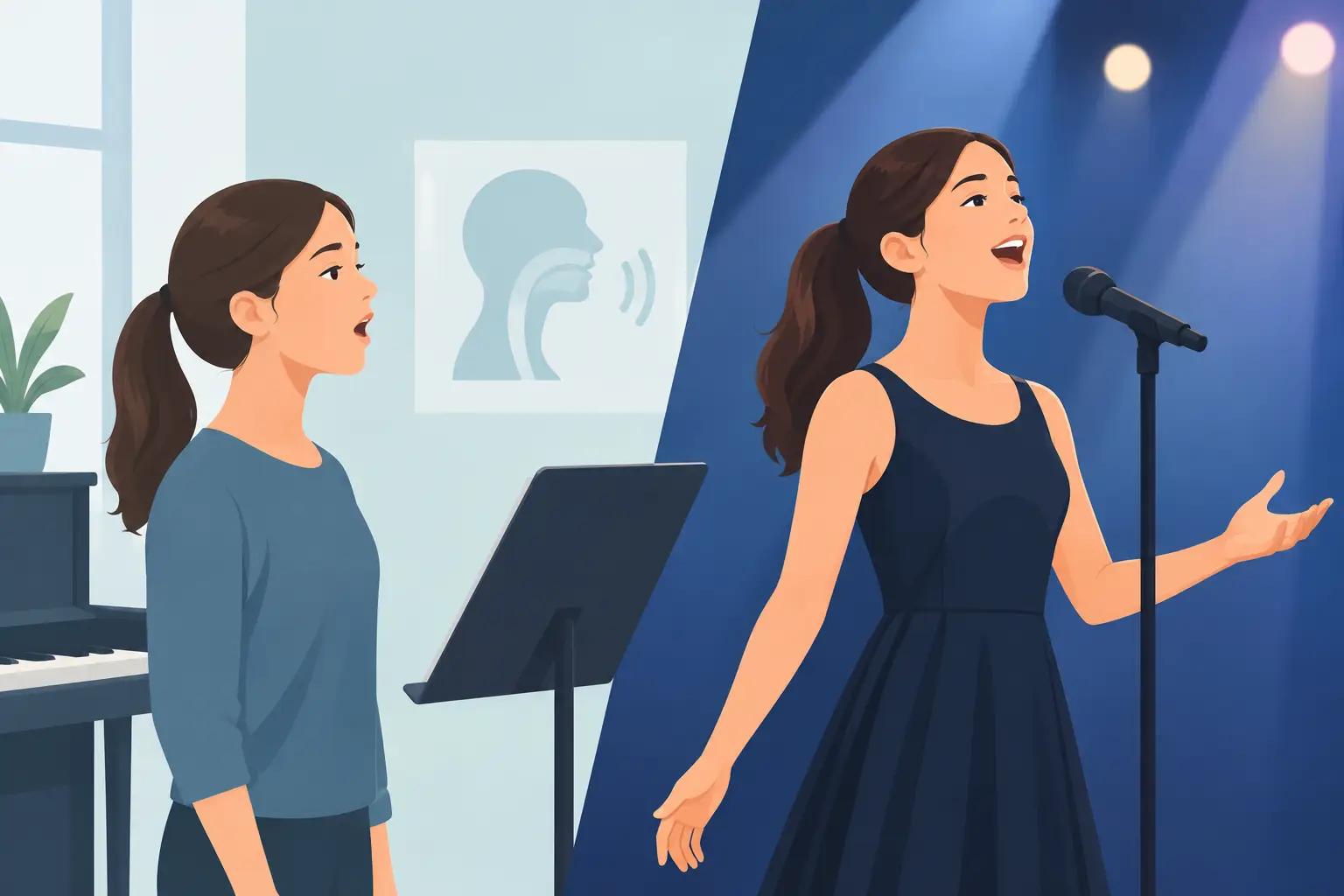
Show choir teaches students to sing with healthy technique while managing choreography, spacing, and audience awareness. They begin to understand breathing, posture, diction, projection, rhythm, and vocal control as practical tools rather than abstract instructions.
Singing while moving requires particular concentration. Students cannot rely on standing still and focusing only on melody. They learn to support the voice through active movement, recover quickly after energetic sections, and keep their sound clear as the performance changes. This is useful preparation for musical theater, school productions, auditions, and any setting where singing needs to feel confident rather than tentative.
Progress looks different at every age. Younger children may focus on singing clearly, staying on beat, and remembering simple actions. Older students can work on harmonies, stylistic choices, musical phrasing, and sustained performance stamina. A well-structured class gives each age group an appropriate level of challenge.
Better coordination, rhythm, and body confidence
Many children enjoy music but feel unsure about dancing. Show choir gives them a welcoming entry point because movement has a clear purpose: it helps tell the song’s story and creates a stronger ensemble performance.
Through choreography, students develop coordination, spatial awareness, timing, and memory. They learn to recognize counts, adjust their energy, and move in sync with a group. Over time, the body becomes less of a distraction and more of an expressive instrument.
This benefit extends beyond the studio. Better body awareness can help students stand taller when presenting at school, move with more confidence in social settings, and approach unfamiliar physical tasks with less hesitation. Not every student will want to pursue formal dance training, and that is perfectly fine. Show choir still gives them a practical foundation in movement and rhythm.
Confidence built through preparation, not empty praise
Real confidence comes from knowing, “I have practiced this, and I can do it.” Show choir creates repeated opportunities for students to prepare, receive feedback, improve, and perform. That cycle is powerful.
A student may begin by worrying about singing in front of others. Then they learn one phrase, one formation, and one section at a time. By the time performance day arrives, they have evidence of their own growth. They know how much work went into the result.
This matters for children and teens who are naturally reserved, but it also matters for students who already love the spotlight. Confident performers need discipline too. Show choir teaches that strong stage presence is not about being the loudest person in the room. It is about showing up prepared, staying connected to the ensemble, and giving a committed performance from beginning to end.
Teamwork that is visible and meaningful
In a show choir, every performer affects the group. If one person misses a count, enters early, or loses focus, the formation and sound can shift. Students quickly learn that success depends on paying attention to more than themselves.
They practice listening across the ensemble, matching their energy to the group, respecting rehearsal time, and encouraging teammates through difficult sections. These are not small lessons. They are the same collaborative skills that help young people in school projects, team activities, and future workplaces.
There is also a special kind of belonging that comes from creating a performance together. Students celebrate shared progress: the first time a difficult routine comes together, the moment harmonies lock in, or the applause after a showcase. For many young performers, this sense of community becomes one of the most lasting rewards.
Resilience and a healthy response to feedback
No performance training is perfect on the first attempt. A student may forget lyrics, struggle with a turn, sing off-key, or feel disappointed after rehearsal. In a positive, professionally guided environment, those moments become opportunities to build resilience.
Show choir helps students separate feedback from failure. Corrections are part of training, not a judgment of talent. They learn to listen, apply notes, try again, and recognize improvement over time. This mindset is especially valuable for teens navigating academic pressure, social expectations, and growing self-awareness.
The goal is not perfection. The goal is progress, accountability, and the ability to keep going when something feels difficult. Parents often see this growth at home too, as students become more comfortable practicing independently and taking responsibility for what they need to improve.
A stronger foundation for future performance pathways
For students who want to go further, show choir provides broad, practical preparation. It supports skills used in musical theater, vocal performance, dance-based productions, school showcases, and auditions. Because students are trained to sing, move, and connect with an audience, they become more versatile performers.
Versatility matters, but specialization still has its place. A student aiming for advanced vocal work may need additional vocal coaching. A student passionate about dance may benefit from focused technical dance classes. Show choir does not replace every discipline. Instead, it gives performers a strong integrated base and helps families identify where a student’s interests and strengths are leading.
At MADDspace, the Signature Sing & Dance Show Choir curriculum offers this kind of integrated training in a structured, performance-centered setting. Students can build skills progressively while experiencing the energy and discipline of ensemble work.
How to Know Whether Show Choir Is a Good Fit
Show choir is a strong option for children and teens who enjoy music, like being part of a group, or want to become more comfortable performing. They do not need to arrive as polished singers or trained dancers. Curiosity, willingness to practice, and a positive attitude matter far more at the beginning.
It can also be a thoughtful choice for a student who needs a creative outlet but benefits from clear structure. Rehearsals have goals, choreography has counts, songs have cues, and performances have shared responsibilities. That structure gives artistic students a productive way to channel their energy.
Families should consider their child’s schedule and readiness for commitment. Show choir is most rewarding when students can attend consistently, practice key material, and participate in performances when possible. A trial class can be helpful for seeing whether the class energy, teaching style, and level of challenge feel right.
The best part of show choir is often the moment a student realizes they can do more than they first believed. Give them a song, a team, and a stage - then give them the training and encouragement to grow into it.


Comments